
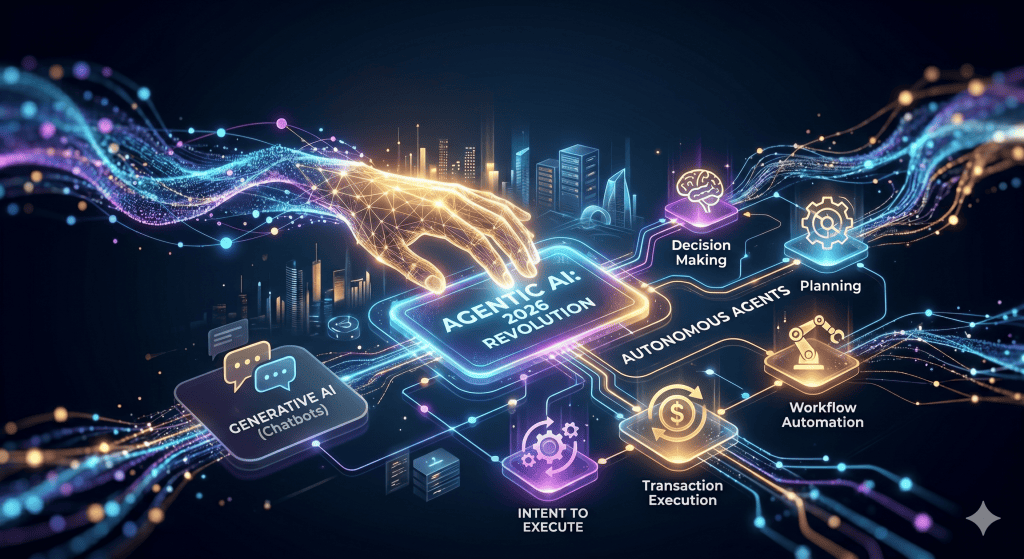
If you feel like you’ve barely mastered the art of writing the perfect ChatGPT or Gemini prompt, brace yourself. The tech world has already moved on.
We are officially leaving the era of generative AI—where algorithms merely answer questions or write emails—and entering the era of Agentic AI. This isn’t just a minor software upgrade; it is a fundamental shift in how humans interact with technology. If 2024 and 2025 were about AI that talks, 2026 is the year of AI that acts.
What is Agentic AI? (And Why It Changes Everything)
For the last few years, artificial intelligence has acted like a highly knowledgeable research assistant. You ask it a question, it gives you an answer, and then it stops. The human still has to do all the heavy lifting: copying the text, opening the email app, scheduling the meeting, or booking the flight.
AI Agents change the entire workflow. An Agent is an autonomous system capable of reasoning, planning, and executing complex, multi-step tasks on your behalf without needing constant human intervention.
Instead of asking an AI to “find flights to London,” you can tell an AI Agent: “I need to attend a conference in London next month. Look at my calendar, coordinate with my team, find the best flights within our corporate budget, book the hotel, and add the entire itinerary to my calendar.”
The Agent doesn’t just give you links; it logs into the systems, makes the decisions based on your pre-set preferences, and completes the transaction.
From “Prompts” to “Intent”: How the Workplace is Being Rewired
The corporate world is experiencing a major paradigm shift. In software engineering, marketing, and network operations, the focus is shifting away from manual coding or execution toward orchestration.
[Old AI Model]  ——> Human Prompts ——> AI Generates Text ——> Human Executes Task
[Agentic Model] ——> Human Expresses Intent ——> AI Agent Plans, Coordinates & Executes
Instead of writing individual blocks of code, developers are now “expressing intent”—defining the desired outcome and letting multi-agent systems build, test, and deploy the architecture autonomously. Marketing departments are deploying autonomous agents that don’t just write ad copy, but actively monitor live campaign performance, analyze customer sentiment in real-time, and dynamically reallocate ad spend across platforms to maximize ROI.
This isn’t about replacing human workers; it’s about elevating them. By offloading highly repetitive, data-heavy execution tasks to digital agents, professionals are being freed up to focus entirely on high-level strategy, creative breakthroughs, and emotional intelligence—areas where silicon simply cannot compete.
The Rise of Multi-Agent Systems and “Physical AI”
The true magic of this trend lies in collaboration. In mid-2026, we are seeing the explosion of multi-agent networks. Imagine a customer service eco-system where separate, specialized AI agents talk to each other: one understands the user’s emotion, another queries the secure database, a third interprets company policy, and a fourth generates the final, personalized response. They work seamlessly as a team in milliseconds.
Furthermore, this intelligence is rapidly escaping our screens. Physical AI is booming, integrating autonomous decision-making into robotics, warehouse logistics, and smart grids. We are shifting from controlled automation to machines that can perceive, adapt, and handle real-world uncertainty on the fly.
The Next Challenge: Security, Trust, and the “Agentic Guardrails”
As billions of dollars pour into agentic startups, the conversation is rapidly turning toward security. If an AI agent can act on your behalf, how do we ensure it doesn’t make an unauthorized financial transfer? How do we prevent an autonomous network script from accidentally taking down a core system during a routine update?
The hottest sector in tech right now isn’t just building faster models; it’s building Zero Trust AI frameworks and runtime guardrails. Identity and access management infrastructure is being completely redesigned so that companies can securely authenticate and monitor what an AI agent is doing at any given second.
Final Thoughts: Are You Ready for a Silicon Workforce?
The Agentic AI revolution is a wake-up call for every industry. The competitive edge is no longer about who can use AI to write faster; it’s about who can design, govern, and orchestrate the best ecosystem of autonomous digital workers.
The future isn’t about human vs. machine—it’s about the professionals who embrace agentic workflows leaving everyone else in the dust.